
Nailfold Capillaroscopy Treatment in Singapore
Nailfold capillaroscopy is a diagnostic procedure used to examine the small blood vessels (capillaries) in the skin at the base of the fingernails. This non-invasive technique provides valuable information about microcirculation and is particularly useful in diagnosing and monitoring certain rheumatic diseases.

What is Nailfold
Capillaroscopy?
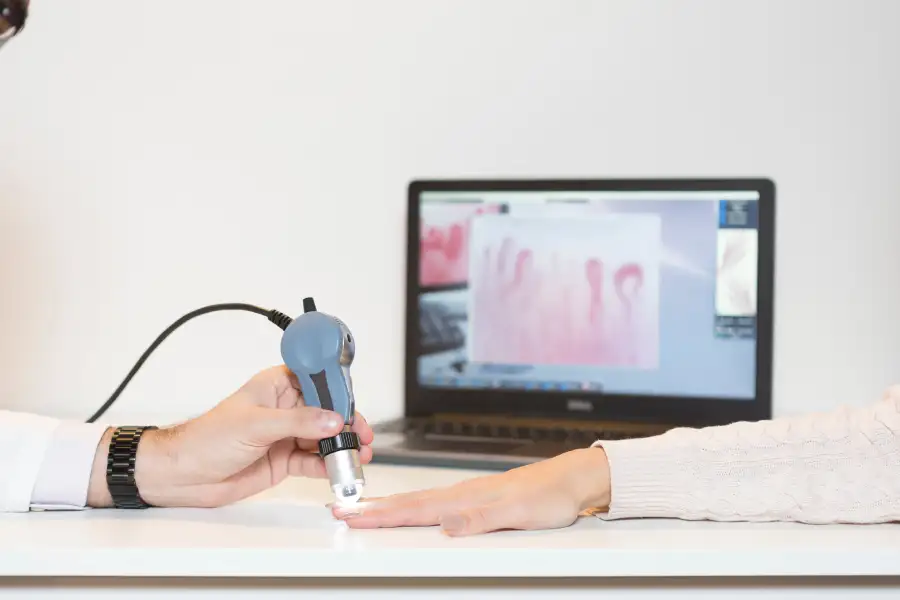
Nailfold capillaroscopy is a diagnostic imaging technique that visualises the tiny blood vessels near the skin surface at the nail bed (nailfold). By using a microscope or a specialised imaging device, doctors can assess the structure and function of these capillaries.
Purpose of Nailfold Capillaroscopy
- Diagnosing Rheumatic Diseases – Helps in diagnosing conditions like systemic sclerosis (scleroderma), dermatomyositis, and other connective tissue diseases.
- Monitoring Disease Progression – Tracks changes in capillary patterns over time in patients with known rheumatic diseases.
- Evaluating Vascular Health – Provides insights into the health of the small blood vessels, which can be indicative of broader systemic issues.

The Procedure
Nailfold capillaroscopy is a simple, non-invasive procedure that can be performed in a doctor’s office.
Here’s what you can expect:

Preparation
- No Special Preparation – Generally, no specific preparation is needed.
- Clean Hands – Ensure your hands are clean and nail polish is removed for clear imaging.
- Relaxed Environment – The procedure is painless and usually done in a relaxed setting.
Duration
The entire procedure typically takes about 10 to 15 minutes per hand, depending on the number of fingers examined.
During the Procedure
- Positioning – You will be seated comfortably, and your hands will be placed on a flat surface.
- Application of Immersion Oil – A drop of immersion oil is applied to the nailfold to improve the clarity of the images.
- Imaging – The doctor uses a microscope or a capillaroscope to examine the nailfold capillaries. This involves gently pressing the imaging device against the skin at the base of the fingernail.
- Observation and Recording – The capillaries are observed, and images are recorded for further analysis.

Interpretation of Results
The images obtained from nailfold capillaroscopy provide detailed views of the capillaries, allowing doctors to assess various aspects of microcirculation. Here’s what they look for:
Normal Capillary Patterns
- Regular Shape and Size – Capillaries should appear as regular, loop-shaped structures. Uniform Distribution – Capillaries are evenly distributed with consistent spacing.
- Uniform Distribution – Capillaries are evenly distributed with consistent spacing.
Abnormal Findings
- Enlarged Capillaries – Indicate potential damage or abnormal growth.
- Hemorrhages – Small blood spots within the capillaries suggest bleeding.
- Capillary Dropout – Areas where capillaries are missing, indicating loss of microcirculation.
- Tortuous Capillaries – Twisted or deformed capillaries can signal underlying vascular issues.
Common Patterns in Specific Diseases
- Systemic Sclerosis – Giant capillaries, haemorrhages, and capillary dropout are characteristic findings.
- Dermatomyositis – Enlarged capillaries and a higher density of capillaries may be observed.
- Lupus Erythematosus – Can show a variety of capillary abnormalities, including dilated loops and haemorrhages.

Significance of Nailfold Capillaroscopy
Nailfold capillaroscopy is a valuable tool in the diagnosis and management of several rheumatic diseases.
Here’s why it’s important:
Identifies Early Changes
Detects early microvascular changes before other symptoms appear, aiding in early diagnosis and intervention.
Tracks Progression
Monitors changes in capillary patterns over time, helping to assess disease progression and the effectiveness of treatments.
Predicts Outcomes
Certain capillary abnormalities can indicate the likelihood of disease progression or complications, helping to guide treatment decisions.
No Discomfort
The procedure is painless and poses no risk to patients, making it a preferred choice for ongoing monitoring.
When is Nailfold Capillaroscopy Recommended?
Your doctor may recommend nailfold capillaroscopy if you have symptoms or a diagnosis suggesting microvascular involvement.
Common indications include:
Raynaud’s Phenomenon
Persistent symptoms of Raynaud’s, such as colour changes in the fingers in response to cold or stress.
Suspected Systemic Sclerosis
Symptoms like skin thickening, joint pain, or difficulty swallowing.
Dermatomyositis and Polymyositis
Muscle weakness, skin rashes, and other signs of inflammatory muscle disease.
Other Connective Tissue Diseases
Such as lupus or mixed connective tissue disease, especially with unexplained symptoms or vascular involvement.
Preparing for Your Appointment
While nailfold capillaroscopy requires minimal preparation, keeping a few things in mind can help ensure a smooth procedure:
Tips to prepare:
Remove Nail Polish
Make sure your nails are free of polish and other cosmetic products.
Report Symptoms
Inform your doctor about any symptoms you’re experiencing, particularly those related to blood circulation or rheumatic diseases.
Follow Instructions
Follow any specific instructions given by your healthcare provider.
Nailfold capillaroscopy is a powerful diagnostic tool that provides critical insights into the health of microcirculation, particularly in patients with rheumatic diseases. Its noninvasive nature, combined with its ability to detect early vascular changes, makes it invaluable in both diagnosis and disease management.
Gain Clarity Through Nailfold Capillaroscopy
with Dr Anindita Santosa
Colour changes in the fingers may occur as an isolated form of Raynaud’s phenomenon or alongside an underlying connective tissue disease. Nailfold capillaroscopy provides a painless, magnified view of the small blood vessels at the base of the fingernails, revealing changes such as enlarged capillaries, haemorrhages or capillary loss. Interpreted with your symptoms, examination and test results, these findings can support earlier diagnosis and ongoing monitoring.
At Aaria Rheumatology, nailfold capillaroscopy forms part of a broader assessment tailored to your symptoms and clinical history. Rheumatologist Dr Anindita Santosa examines the capillary patterns and explains how they may relate to Raynaud’s phenomenon or a connective tissue condition.
If your fingers repeatedly change colour in response to cold or stress, or you have skin tightening or other unexplained symptoms, contact us today to book an appointment.
